Guides
What Is Nan Khatai? Its Story, Serving and Storage
What nan khatai is, how its story is told across the subcontinent, how to serve it with chai, and how to keep it crisp in Lahore weather.
By The Golden Crust Bake Team · · updated · 7 min read
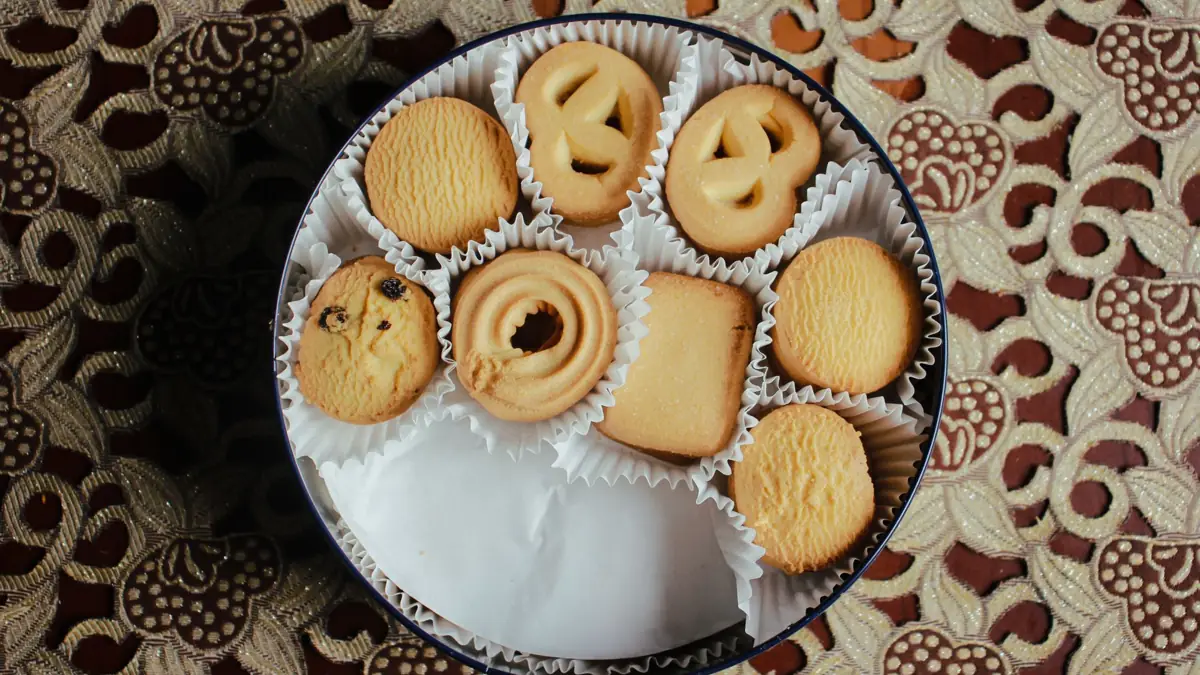
Quick answer: nan khatai is a crumbly, buttery, cardamom-scented biscuit from the Indian subcontinent, somewhere between shortbread and a cookie. It is traditionally made with flour, sugar and ghee or butter — usually without eggs — and is best eaten with a hot cup of chai. Kept in an airtight tin, it stays crisp for more than a week.
Ask anyone who grew up in Lahore about nan khatai and you will probably get a story rather than a definition — a grandmother's tin on the top shelf, the bakery box that arrived with guests, the biscuit that crumbled into the chai if you dunked it a second too long. At our Central Bakehouse, nan khatai is one of the quietest bakes of the morning: no cream, no decoration, just trays of pale domes that crack and turn golden as they bake. Here is what it is, where its story is said to begin, and how to enjoy it at its best.
Key takeaways
- Nan khatai is a shortbread-style biscuit flavoured with cardamom, often with semolina or gram flour.
- Its origin story is often linked to Surat and Dutch-era bakeries, though accounts differ.
- It is typically made without eggs, but recipes vary.
- Store it in an airtight tin; humidity is what softens it.
What exactly is nan khatai?
Nan khatai is a small, round, crumbly biscuit made from flour, sugar and fat, usually scented with green cardamom and baked until it cracks on top. Its texture is the giveaway: it is short and sandy, so it melts on the tongue rather than snapping like a crisp cookie. The characteristic crackled dome forms as the dough spreads and sets in the oven.
How is it different from shortbread or a cookie?
All three are cousins, but nan khatai has its own personality.
| Biscuit | Typical fat | Typical flavour | Texture | Eggs? |
|---|---|---|---|---|
| Nan khatai | Ghee or butter | Cardamom, sometimes nuts | Sandy, crumbly, melts in the mouth | Usually none |
| Scottish shortbread | Butter | Plain butter | Dense, crisp-tender | Usually none |
| Chocolate chip cookie | Butter | Vanilla, chocolate | Crisp edges, chewy or crunchy | Usually yes |
| Almond biscotti | Butter or none | Almond, vanilla | Very hard, twice-baked | Usually yes |
That table is a general description of traditional styles — every bakery's recipe differs. You can find our own versions of each in the biscuits collection.
What goes into nan khatai?
The basic recipe is simple, which is exactly why technique matters:
- Flour — usually fine wheat flour (maida), and in many recipes some semolina (sooji) or gram flour (besan) for a nuttier, grainier bite.
- Sugar — finely ground, so the biscuit stays smooth.
- Fat — ghee gives the traditional flavour; butter gives a richer, dairy note. Some bakeries use a blend.
- Cardamom — the signature aroma.
- A raising agent — a little baking powder or soda helps create the cracked top.
- Optional toppings — a sliver of almond or pistachio pressed into the centre.
Where does nan khatai come from?
Nan khatai is generally linked to the Indian subcontinent, and the most commonly told story places its beginnings in Surat, the old trading port in Gujarat. The way it is often told, Dutch traders in the city left behind bakeries, and when their bread lost favour with local customers, a local baker began drying and then reshaping the dough into a sweet biscuit that became popular. Versions of this story appear in many food write-ups, but it is a piece of culinary folklore rather than a documented fact, and accounts differ on the details.
What does the name "nan khatai" mean?
The name is usually explained as a combination of two words, but explanations vary. "Naan" is commonly traced to Persian, where it means bread. "Khatai" is often said to come from a word connected with Cathay or with northern regions — some accounts link it to Afghanistan or Central Asia, others suggest different roots. Because the etymology is told in several ways, we prefer to say simply that the name points to the trade and cultural routes that brought Persian, Central Asian and South Asian food traditions together.
How did it become a Pakistani favourite?
Over generations, nan khatai spread through bakeries and home kitchens across the subcontinent, and it is now firmly part of everyday life in Pakistan as well as India. In Lahore, it sits on bakery counters next to cake rusk and biscuits, appears on Eid tables, and is a classic gift when visiting family. Its popularity likely comes from simple things: it keeps well, it travels well, it suits the chai culture, and it is made from pantry ingredients.
How do you serve nan khatai with chai?
Serve two or three pieces on a small plate beside a hot cup of doodh patti — the strong, milky, sweet tea brewed in milk. That pairing is the heart of nan khatai's appeal: the richness of the biscuit balances the strength of the tea, and the cardamom echoes the spices many households add to their chai.
- Brew the chai first. Nan khatai is best eaten while the tea is hot.
- Warm the plate slightly in cold weather — not the biscuits, just the plate.
- Dunk quickly, if you dunk at all. Nan khatai is short and crumbly, so one second is plenty; any longer and half of it ends up at the bottom of the cup.
- Pair with something savoury for a full tea-time spread — a patty or puff makes a good contrast.
- Offer a second sweet such as cake rusk for guests who like a firmer biscuit to dunk.
Our tea-time selection brings these together, and at our branches you can pair nan khatai with a freshly made doodh patti chai.
Is nan khatai only for tea time?
Not at all. It is a staple of Eid hospitality — see our Eid dessert table guide for how to fit it into a wider spread — and a box of nan khatai is a thoughtful gift when visiting relatives or new neighbours. Some people crumble it over ice cream or kheer for a little crunch.
How should you store nan khatai so it stays crisp?
Keep nan khatai in an airtight tin or jar at room temperature, away from the stove and out of direct sun. Moisture is what turns it soft, so in Lahore's humid monsoon months the lid matters more than anything else.
| Storage method | How it holds up | Our view |
|---|---|---|
| Airtight tin or glass jar, room temperature | Stays crisp for well over a week | Best everyday option |
| Original box, opened and left on the counter | Softens within a few days in humid weather | Transfer to a tin after opening |
| Fridge | Can pick up moisture and fridge smells | Not recommended |
| Freezer, well wrapped | Keeps for weeks; thaw in the wrapping | Fine for stocking up before Eid |
| Tin shared with cake or bread | Absorbs moisture and goes soft quickly | Avoid |
Can you re-crisp soft nan khatai?
Yes. Spread softened biscuits on a tray and warm them in a low oven for five minutes or so, then let them cool completely on the tray. They will firm up again as they cool. Store them straight back in an airtight tin.
Is nan khatai suitable for people with allergies?
Nan khatai contains wheat (gluten) and dairy if made with butter or ghee, and some versions contain nuts. It is traditionally made without eggs, which makes it a common choice for people avoiding eggs — but every recipe is different. Our bakes are made in a shared kitchen that handles wheat, eggs, milk, tree nuts including almonds, soy and sesame, so cross-contact is possible. Please check our allergen information for the exact details of our nan khatai before buying for anyone with an allergy.
How do you tell a good nan khatai?
Look for an even golden base, a pale crackled top, and a biscuit that breaks cleanly but crumbles softly in the mouth. A good nan khatai smells of ghee or butter and cardamom the moment the box opens. If it is hard and glassy, it has been over-baked; if it is soft and doughy in the middle, it is under-baked or has picked up moisture.
A few signs of care to look for:
- Uniform size and colour across the box, showing a steady bake.
- A fragrance, not a perfume — cardamom should be gentle, not overpowering.
- No greasy patches on the box, which can mean too much fat or poor storage.
Our nan khatai is baked at the Central Bakehouse in Kot Lakhpat and sent to the counters in Gulberg, DHA Phase 5 and Johar Town. Pick up a box with your chai, or add one to your next order from the biscuits collection — and keep the tin closed tightly between cups.
Frequently asked
What is nan khatai made of?
Nan khatai is a shortbread-style biscuit made mainly from flour, sugar and fat such as butter or ghee, usually flavoured with cardamom. Many recipes add semolina or gram flour for texture, and some are topped with almonds or pistachios. Recipes vary by bakery and family.
Where does nan khatai come from?
Nan khatai is generally linked to the Indian subcontinent, and the story most often told places its origins in the port city of Surat, connected to Dutch-era bakeries. Accounts differ, and the history is passed down more through tradition than firm records. Today it is loved across Pakistan and India.
How long does nan khatai stay fresh?
Nan khatai stays crisp for well over a week when kept in an airtight tin at room temperature. Humidity is its main enemy, so close the tin firmly after each opening. Check the keeping time on the product page for our own nan khatai.
Is nan khatai eggless?
Traditional nan khatai is usually made without eggs, which is part of its crumbly, melt-in-the-mouth texture. However, recipes differ and our bakes are made in a shared kitchen that handles eggs. Check our allergen page for the details of each product before buying.
What is the best way to eat nan khatai?
The classic way is with a hot cup of doodh patti chai, either dunked quickly or eaten alongside. It is also served to guests at Eid, given as gifts in boxes and enjoyed as a simple sweet after dinner.